
When the Larger World Entered Our Small Suburban Garden
We lost our beehive this week. But some losses carry the weight of a much larger story.

Welcome to Age with Attitude, where I explore one question:
What sustains a life as we age?
Our beehive died this week.
In the scheme of world suffering, it is a small event. People lose partners, parents, pets, and homes. A backyard beehive should not feel like a catastrophe.
But grief does not always follow the hierarchy of importance. Sometimes it attaches itself to the place where a much larger story enters a personal one.
This was not only the loss of a hive. It was the arrival of scale. Existential anxiety often arrives dressed as something ordinary. Today, it arrived as an empty beehive.
The hive was a COVID project.
We needed to refocus our energy away from that unfolding global catastrophe.
We needed to feel like we still had some agency.
We needed to care.
I bought Frank a beekeeping course for his birthday in March 2021. He is a natural animal carer and was a bit lost when we left our tiny farm for a beach house.
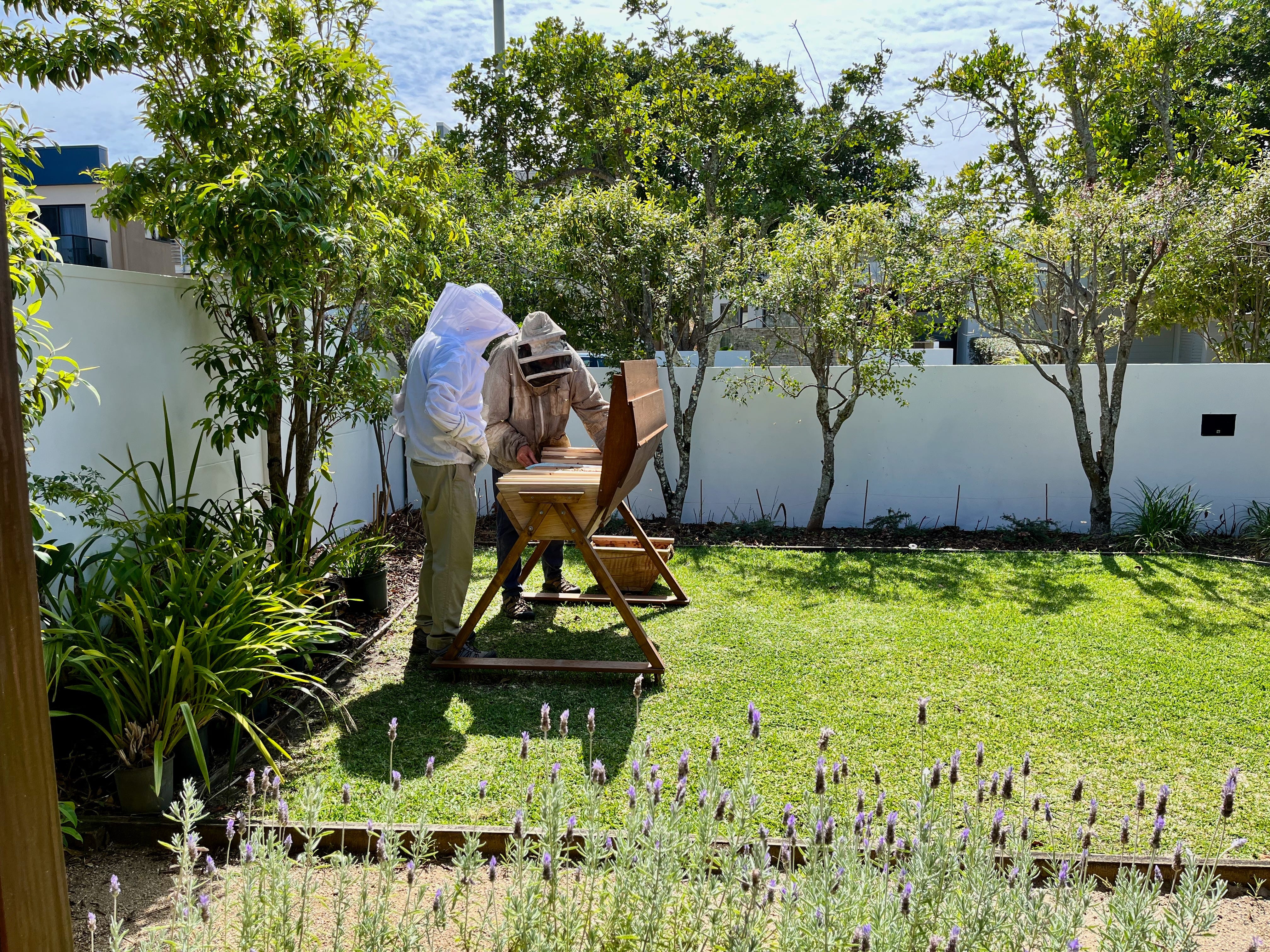
He bought a Top Bar hive flatpack and set about building it. As well as being more natural than the standard hive, I preferred its look as garden furniture.
Even before we received our bees, we joined the local beekeeping club. Frank set about watching hours of YouTube videos to learn everything he could.
It was an exciting day when the workshop leader arrived with a nuc hive (a nucleus colony), a miniature, fully functioning beehive, consisting of 3 to 5 frames holding a laying queen, worker bees, brood, and food stores and helped Frank set it up.
He was so calm around the bees. I was in awe of the way he let them fly around his uncovered face as they got to know him.
We loved to sit on our deck to watch these incredible creatures go about their ancient work. They soon found their new flight path and danced for each other to show where the best nectar was.
A couple of months later, it was time to collect honey. Frank suited up. Too hot for the full suit here, so he had donned the top half but taped his shorts to his thighs. Ten to twelve kilograms of luscious honey from our one backyard hive per year. Plenty to gift to friends and family.
Then our first swarm happened. A queen exits the hive with half the hive, up into a tree, before setting out to find a new place to live. (a normal hive reproduction process) Frank pulled out his spare nuc box and, with bare hands, coaxed them gently into it from the tree. Now there was a nuc for someone else wanting to start or expand their hives. Our hive set about re-queening.
Frank would put a beach umbrella over them when it was too hot and cover the hive in the pouring rain. He would answer my or anyone else’s endless questions.
He loved getting young family members up close and personal with bees. A window at the back of the hive allowed a view of the inner workings of the hive. My great-nephew was obsessed. He would save his money to buy honeycomb from Frank on his visits.
How could such tiny creatures provide so much joy?
Then, last week, as we sat on the deck with our usual morning coffee, I noticed bees on the ground.
Not one or two.
Many.
They were struggling to fly. Some crawled. Some turned in circles. Something was wrong. At first, we hoped it was the cold snap. Frank put insulation into the hive.
We watched. We waited.
But I think we both knew.
It was painful to watch. The depth of the sadness took us by surprise.
You know that feeling when you lose a pet. The ache is intimate and specific. These were not pets in the usual sense, but they were ours in the way a living thing becomes yours when you have cared for it.
We were not owners so much as stewards.
And perhaps that is why the grief felt different. It was not only affection. It was responsibility. It was helplessness. It was the knowledge that this tiny collapse belonged to something much larger.
The biosecurity breach.
Varroa destructor (varroa mite) was first detected in Australia in June 2022, in sentinel hives at the Port of Newcastle in New South Wales.
For more than a year, the biosecurity response was intense. Hive movements were restricted. Infected and exposed hives were euthanised. Beekeepers tested, reported, waited, watched maps, and hoped the line would hold.
We did everything asked of us.
We’d already registered our hive. We tested regularly. We watched the affected-area map slowly spread towards us in pink.
In September 2023, eradication was declared no longer feasible. Australia moved from trying to keep Varroa out to learning how to live with it.
That sentence sounds administrative.
It is not.
It means the burden shifted to every beekeeper, commercial and backyard. It means treatments, testing, timing, cost, loss, and constant vigilance. It means feral honey bee colonies—the swarms that once escaped into trees and hollows and kept pollinating without anyone managing them—are likely to collapse in vast numbers.
It means pollination becomes less invisible.
Honey may become more expensive. Pollination services may become more difficult. Crops that depend on managed honey bees may become more vulnerable. The quiet architecture behind ordinary food begins to show itself.
This is not only our hive.
This is Australia.
This is pollination.
This is the fragile architecture behind our food.
I usually write about what sustains a life as we age.
But this week, standing beside an emptying hive, the question widened to:
What sustains life?
Not in the abstract. Not as a slogan. But here, in our garden, in the hum we took for granted, in the pollination we barely noticed, in the systems that kept working quietly until they didn’t.
We cannot hold the whole system steady.
But we can notice what is being lost.
We can care for our small corner.
We can refuse to look away.
Sources consulted:
Australian Government Varroa mite outbreak updates;
NSW Department of Primary Industries Varroa mite information;
Australian Department of Agriculture pest profile;
ABC News reporting on Varroa in Queensland.
I’d love to hear how this lands for you.
Hit the Like button below, or let’s continue the conversation in the Comments.
My Favorite Reads this week:
On Walden Pond, with Wi-Fi by Dave Williams
Yes, I am in my 80s, but I’m Still Making New Friends by Ann Richardson
Spending in Retirement: From Accumulating to Allowing by Retirement For Newbies
Heartbreaking, Robyn. For you. Australia, and the entire world. I fear it is a harbinger of what we will have to “live with” in the future, but it’s no small thing.
You’re right- about the stewardship. That’s what makes the loss all the more tragic. Thank you for sharing this story. It must have been a difficult one to write.