
Holding a Small Corner of the World Steady
When global shocks ripple outward, perhaps the work of elders is simple: care for what is close enough to touch.

The button has been pressed.
Bombs explode across our television screens.
The reverberations are already moving outward. Eventually, we will all feel the impact.
Fuel prices will rise. Supply chains will tighten. Some will profit from the chaos, further destabilising already fragile systems.
War rarely stays where it begins.
I am grateful my family safely returned to the UK after my birthday celebration.
What do we do with this kind of news?
A few weeks ago, I wrote about existential anxiety. Suddenly, it feels less theoretical. It is right in our faces. We want to shout at the television. We want to vent.
But in that article, I wrote about remaining coherent.
So, I turn away.
I read.
This afternoon, I am sitting on our front deck with my Dad beside me. Two peas in a pod, each with our book, no need for small talk.
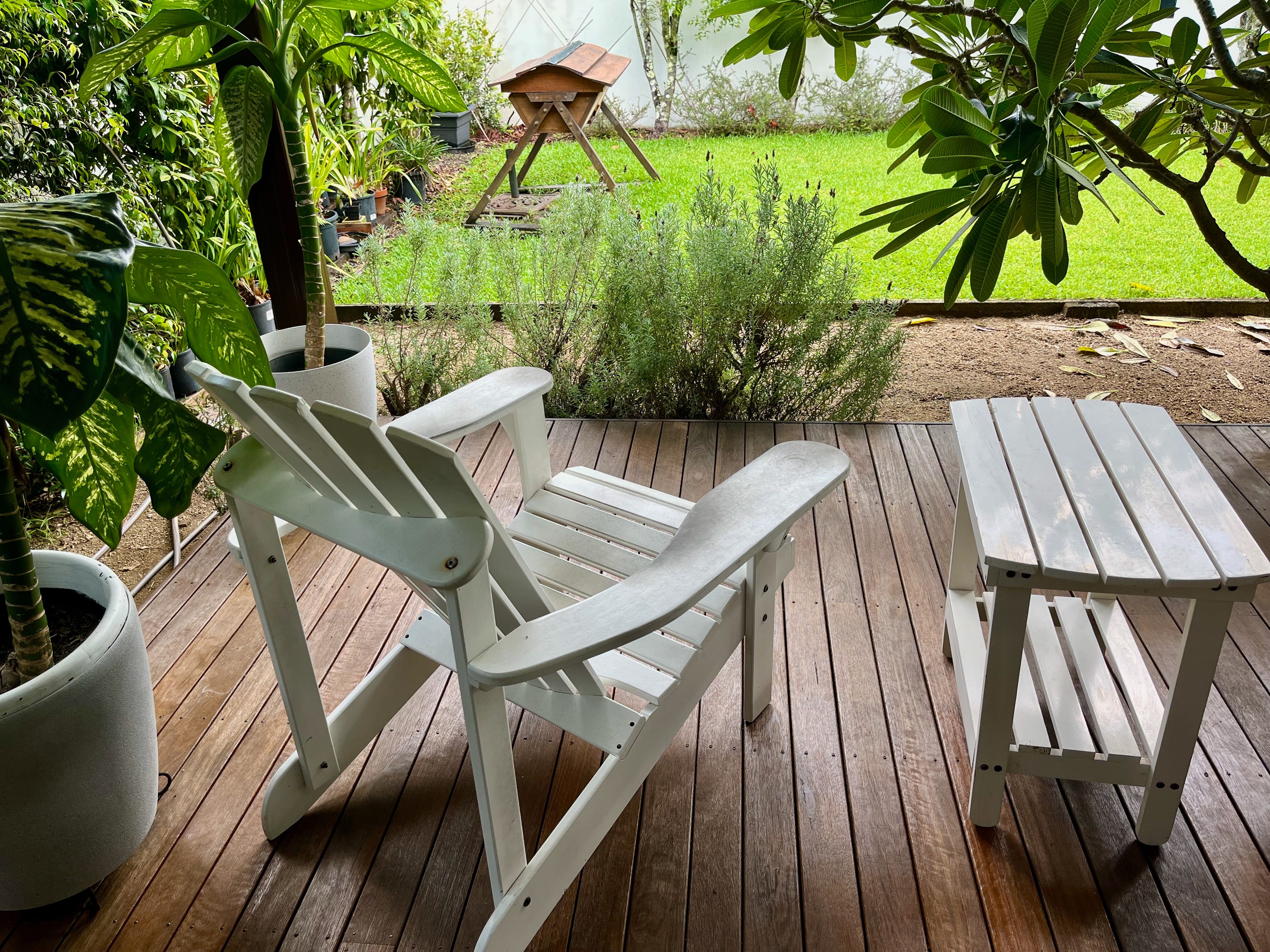
We have settled into white Adirondack chairs that are beginning to show their age and could use a repaint. Dad has a cushion under him and a pillow behind his back to soften the seat. A small table sits between us for drinks and snacks.
The deck could do with a sweep as well, but that can wait until after Dad’s visit.
It is mid-afternoon on a warm summer day here in Australia. A slight breeze keeps us outside enjoying nature rather than retreating into air-conditioning.
The frangipani tree is in full summer leaf, deep, lush green, giving us shade and privacy from passersby.
Our bees are oblivious to the news and carry on with their ancient work.
An occasional bird call breaks the quiet. A small willy wagtail darts about on the lawn.
Nature hasn’t received the memo that the world is in crisis.
The street is quiet. It feels far from the madness, although are we ever truly far from anything on this small planet?
Dad is reading The Secret River by Australian author Kate Grenville. It is a powerful story that echoes the journey of many Australian families, including ours. A life that began in London in the late eighteenth century, transportation as a convict, and the slow building of a new life in Australia.
We sit here today as fifth- and sixth-generations from that convict ancestor who arrived on the First Fleet. That line already continues forward to Dad’s 4 children, 11 grandchildren, and the 30th great-grandchild currently being incubated. We are all linked to an English past in which the class system rarely gave families like ours a chance to build a life of freedom. Australia did.
But have freedom, prosperity and growth breached human limits?
That question sits at the centre of my book Tools for Conviviality by Ivan Illich.
Illich, writing in the 1970s, believed humanity was approaching limits. Systems that once promised prosperity and growth were beginning to push beyond the scale that served human life.
His arguments are not easy reading. Sentences contain arguments within arguments. But as I wrestle with them, I sense the simplicity of his thesis. Philosophical books have a way of shifting how you see the world. And once seen, you cannot easily “unsee”.
I find myself thinking about my place in our long family history as the world shifts beneath our feet.
Now that I have turned seventy, it feels necessary to upgrade my reading to philosophy to prepare myself, in some small way, to become a steward for the generations of our family who will inhabit a very different world.
What is my role?
Read widely.
Think deeply.
Model a way of being.
Write from lived experience.
As Dad and I sit in relative peace, I realise something else.
What Illich talks about and what Dad has demonstrated over 93 years is surprisingly simple.
Life is lived at small scale. The scale at which humans can actually care.
A garden.
A conversation.
A quiet afternoon with family.
A book shared across generations.
And of course, a weekly game of golf with his buddies and a fishing trip with family.
Large systems may shake and fracture. Wars erupt. Oil prices spike. Politicians posture.
But life itself still unfolds in places like this shady front deck, a local golf course, or a beach in the early-morning light, fishing rods ready.
Perhaps that is our work as elders.
Not to control the world.
But to steward the small places entrusted to us.
To care for what is close enough to touch.
The deck will get swept.
The chairs will get repainted.
The bees will keep making honey.
And I hope we have many more opportunities to sit with our books, father and daughter, holding our small corner of the world steady.
My favourite posts this week:
Life is Hard by Susan G.S. Abel
Me and Virginia Woolf by Silvia Fiorita Smith
Thank you, Robyn, for the nod sent my way.
I, too, find the desire, or maybe need, to read deeper and lean more towards the classics. I am challenged to keep up with my husband and son, who read much more than I do. Oddly, it's both comforting and disturbing that we still don't know the answers to so much. History repeats itself.
Such a comforting and beautiful scene compared to what we are seeing on our TVs.