
Hot and Bothered!
As I watch France swelter, I am reminded about what a recent Australian summer taught me about heat and an aging body.

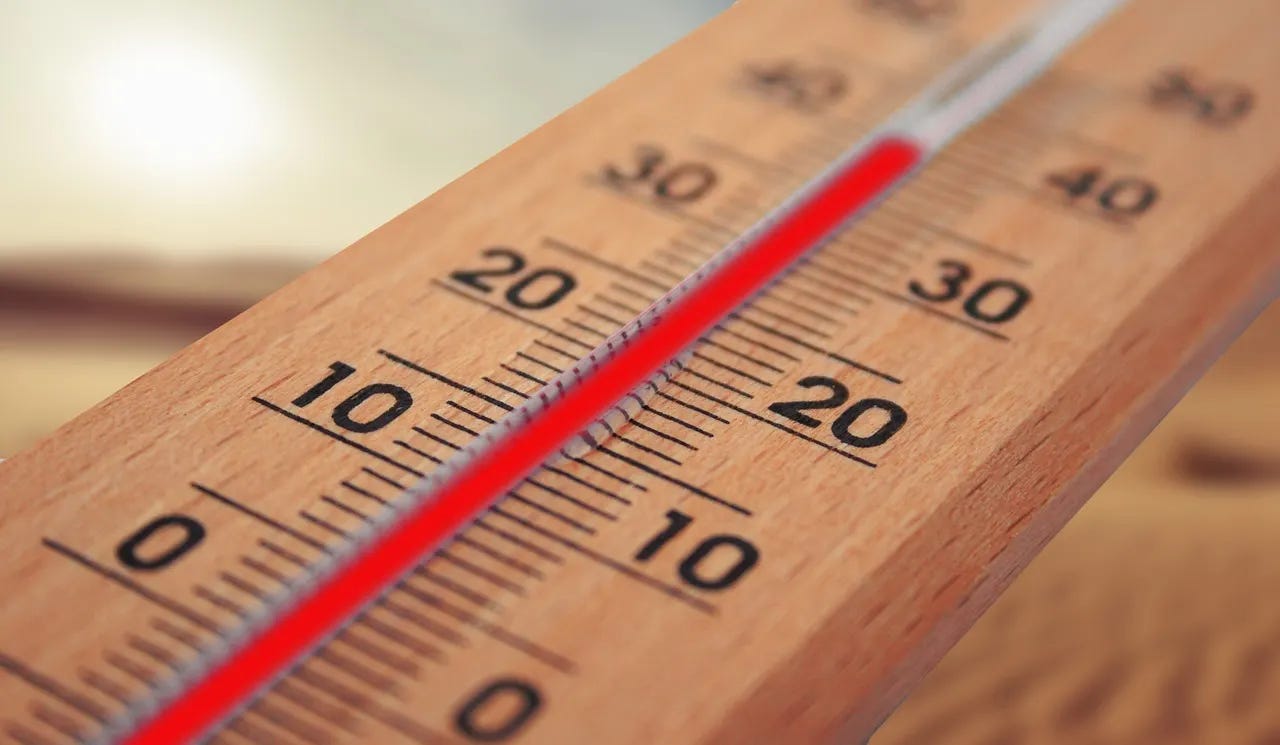
Earlier today, I read Janice Macdonald’s essay about the fear she now feels during the increasingly intense summer heat in France.
At the same time, I have been watching photographs of my granddaughter and her partner holidaying in Nice, where temperatures have been similarly oppressive. They are young, and the heat appears as part of the adventure. For Janice, at 81, it has become something more threatening.
It took me back to an essay I wrote during an oppressive Australian summer a couple of years ago, when falling HRV numbers alerted me to what the heat was actually doing to my body.
I was younger than Janice is now, but I had begun to encounter the same unsettling convergence: the climate was changing, and so was my capacity to tolerate it.
As France swelters and Australia enjoys a winter reprieve from that same oppressive heat, this older piece felt worth bringing back into the conversation. I want to let those of you in the Northern Hemisphere know that we Aussies understand, and we feel your discomfort. Take care.
Welcome to Age with Attitude, where I explore one question:
What sustains a life as we age?
It’s hot, so hot.
Even an early morning walk is no escape. It is already close to 30 (86) degrees and 90% humidity.
Luckily, our path is mostly shaded. I eye off the very attractive activewear adorning beautiful bodies on their morning walks, but my mind fixes on how hot those long leggings must be. Very sweaty clothes stuck to very sweaty bodies. I know how difficult it is to peel my loose-fitting clothing off afterwards. I can only imagine what it takes to get fitted activewear off a sweaty body.
And then, do you know how impossible it is to get bathers onto a sweaty body for a cooling dip in the pool? Just jump in sans clothes is hubby’s advice. No one will see you!
It might be hot, but I am more concerned about a sliding HRV (heart rate variability) number and a sliding VO2 Max number. Everything has been tested to improve these numbers; the determined me unwilling to admit aging as the reason for the slide.
I’ll come back to HRV in a minute.
Last night, the weather reporter told us that these are the highest March temperatures on record. ‘March heat records have been smashed’ were her exact words.
A recent key piece of research tells us that “Over the last 100 years, heatwaves have killed more Australians than all other natural hazards combined”. And that is before we factor in Climate Change.
Over 65s were 9% more likely to die in a heatwave, followed by those with respiratory conditions at 7%.
I also discovered that there are now two heat bands referred to.
Severe and Extreme heat waves.
More people die in the Severe than in the Extreme. Why, you ask? Because in a Severe heat wave, we think we can just keep going and don’t take it as seriously as an Extreme heatwave, where we don’t need to be told to stay indoors with air conditioning until it passes
It doesn’t matter whether you think Autumn starts on the 1st of March or the Equinox on the 21st of March; we should have eased into Autumn by now!
I discussed my sliding HRV woes with my doctor on a recent visit. She was rather unsympathetic, knowing my HRV matches a 40-year-old demographic rather than my actual 60+ age. However, she said it was the heat and left it at that.
Yeah, yeah, I thought. I’ve grown up in the heat, the first 20 years in very hot, dry heat, then in hot, humid subtropical heat. Don’t like either, but you just deal with it until it is over.
But the conversation stuck with me, so I started to have a deeper look at the heat effect. Could it be possible that heat and my HRV requiring resuscitation are related?
Let’s take a closer look.
The issue of hydration or dehydration comes up. I have never been too concerned about hydration, thinking that I drink enough, but do I?
I know that in a dry climate or during high-intensity exercise, dehydration can occur more rapidly due to increased fluid loss through sweating and evaporation. Dry-climate dehydration symptoms include thirst, dry mouth, headache, and dizziness.
In humid tropical or sub-tropical conditions, the air is already saturated with water vapour, so sweat doesn’t evaporate easily. Sweat is the body’s way of cooling itself, but if it can’t evaporate, the body doesn’t cool as efficiently. So, we feel hotter and sweatier than usual, causing us to lose more fluids and electrolytes. Dehydration in humid climates may be less noticeable, but symptoms include fatigue, muscle cramps, and nausea.
This stopped me in my tracks.
Dehydration can significantly affect your HRV. When you’re dehydrated, the body loses fluid, which can reduce blood volume. This, in turn, can cause your heart rate to increase and your HRV to decrease.
OK, you have my attention now.
How do I know I am hydrating adequately?
I turn to my trusty Apple watch. Will it remind me to hydrate? The answer is: no, it won’t, but I can still count my fluid intake in Apple Health. That’s no help; I need a ping to make me stop and drink, so I look for an app. I decide to test WaterMinder linked to an Apple watch.
Gamified hydration. I love it and add it to my other ‘thousand’ daily habits and trackers.
I add my details, age, activity level, and local weather conditions, link it to Apple and away I go. What, you want me to drink 3.5 litres a day and then adjust upward for exercise activity?
On the first day, in addition to my 5 cups of tea, I drink the required water and feel nauseous.
Then I discover an information section describing the value of different liquids. We all know alcohol isn’t great, but it is included in the drinks menu. However, it is adjusted down in value. Beer is adjusted by 0.9, and wine by 0.8. So 100 ml of beer will only count as 90 ml toward the daily intake. On the other hand, electrolyte sports drinks adjust upward; 100 ml produces a 120 ml intake.
Day 2, and I make up a bottle of electrolyte water. The difference is significant. I feel like the fluids are being slurped up by every cell in my body.
I learn that electrolytes play a crucial role in hydration and HRV. Sodium and potassium, for example, help to regulate fluid balance and blood pressure, while magnesium is important for muscle function and energy production. Calcium is necessary for bone health and muscle contraction.
So liquid electrolytes, in addition to foods rich in electrolytes (sodium, potassium and calcium) like fruits and veggies, nuts, seeds and dairy, are front and centre in my daily menu.
WaterMinder also awards stickers every day, telling me how well I am hydrating. What inner child doesn’t love a sticker? Challenges can be added - a 21-day hydration habit, a no alcohol challenge, a no coffee challenge, or even a no caffeine challenge. Perfect for the gamer in me.
In addition to dehydration, heat stress can cause a wide range of HRV-lowering symptoms.
According to this well-researched article, Summer heat can bring on SAD (seasonal affective disorder). SAD is well known in cold climates, but appears to also be associated with heat. Symptoms may manifest as nervous system stimulation, irritability, agitation and the inability to concentrate.
Physiological changes can include increases in metabolism, heart rate, and respiration.
Both these factors contribute to Sympathetic dominance and a lower HRV.
This has been my experience this summer, and there’s been a lot of head-scratching about why I'm feeling anxious and irritable. It’s not me. It was so bad last week that I couldn’t concentrate to finish my Substack article.
So, it’s good to know that it’s not all in my head; there is scientific evidence that heat stress can lower HRV.
Knowing all this helps me to be kinder to myself and seek out strategies to improve HRV by focusing on Parasympathetic activities. Cold therapy (swimming and cold showers) is a great way to stimulate the Parasympathetic nervous system and is much easier in our hot climate than cold swimming in colder climates.
I have to admit that the climate is changing, and I am aging. I appreciate my Elite HRV app data giving me a heads-up about potential health issues before they manifest into serious health problems. I can then fine-tune and continue to Age with Attitude.
Maybe I’ll even get one of WaterMinder’s t-shirts that say ‘Hydrate or Die’ to remind me.
I’d love to hear how this lands for you.
Hit the Like button below, and let’s continue the conversation in the Comments.