
Finding My Intellectual World at 70
I used to read for information and achievement. Now I read to remain in conversation with life.

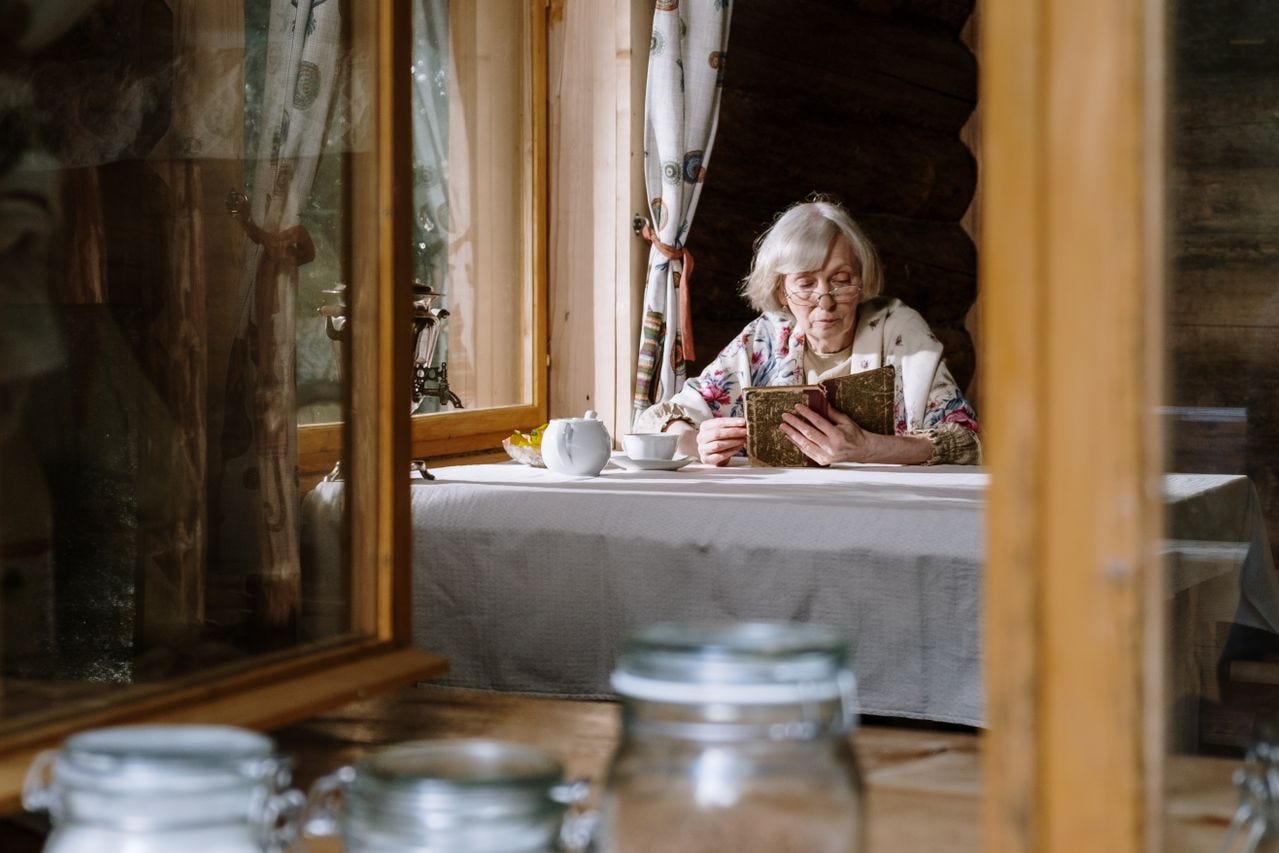
Welcome to Age with Attitude, where I explore one question:
What sustains a life as we age?
I find village conversation comforting for about ten minutes.
I enjoy walking through the village, buying bread, knowing the baker. I like the weather exchanged as a greeting, the news of who has moved into which house, the small observations that hold ordinary life together.
And then I want to go home and wrestle with a difficult book.
Perhaps this comes from a childhood spent in rural Australia, followed by an adulthood spent trying to catch up with what was happening in the wider world.
For years, I did that through how-to books and courses on almost everything. I was a prolific reader and researcher. There was always something more to understand, another skill to acquire, another system that promised to help me do life better.
Somewhere beneath all that learning was a longing for city life, especially in Europe. I imagined these cities as places where people gathered around large tables and discussed important ideas. Big thinkers were somewhere out there, engaged in conversations I could not quite access.
I found Substack five years ago and began writing because I had been told to start somewhere and pull the string.
For a while, Substack seemed to offer the intellectual world I had been seeking. But recently, after removing social media apps from my phone, I began to see Substack Notes taking over my attention as another version of the same distraction. A constant stream of brief observations, advice and opinions asking for my attention.
Even many of the essays began to feel bland.
They were not necessarily poor essays. I could see that their readers valued them. But I had begun to want something more. My time felt too valuable to spend reading words that left me exactly where they found me.
I started to notice a difference between kinds of writing. There were information essays that told me something. There were how-to essays that explained what I should do. There were opinion pieces that invited agreement or disagreement.
And then, occasionally, there were essays that sparked me.
They did not simply give me information. They altered the quality of my attention. They made me look again at something I thought I already understood.
I found Henrik Karlsson
Karlsson lives with his wife and daughters on a small, pine-covered island in the Baltic Sea. His life appears to be intensely local, yet his writing places him in conversation with thinkers and readers around the world.
Here was someone enjoying small-scale living without surrendering the larger intellectual world.
His writing seemed to begin with attention: to his children, his marriage, his reading, his work and the texture of an ordinary day. He once wrote that ten thousand hours of conversation with his wife had changed him and brought him into deeper contact with himself and reality.
That sentence stopped me.
Ten thousand hours of conversation.
Not a course completed. Not a qualification earned. Not a productivity system mastered. Attention sustained over years until it changed the person paying it.
Karlsson showed me that a serious intellectual life did not require living in a city or gaining entry to some distant circle of thinkers. It could begin with close attention to the life directly in front of you.
Then I found Venkatesh Rao
Where Karlsson drew me deeper into attention, Rao expanded the frame.
His essay ‘Touching Time’ began with a man lying on a lawn and expanded outward towards spaceship Earth. I loved the way his mind moved from an ordinary moment into a much larger frame.
Some of his essays in Protocolized were harder for me to grasp. But instead of turning me away, that difficulty intrigued me. I had found ideas large enough to want to wrestle with. I loved them.
I realised I did not need to master every argument. I could allow myself to wrestle with an idea without requiring immediate clarity. Confusion did not mean I had failed as a reader. Sometimes it meant I had reached the edge of what I already knew.
Rao also runs a book club. His 2026 reading list, The Divergence Machine, explores the emergence of modern civilisation through books I would probably never have encountered on my own.
I began with the April selection, Andrea Wulf’s The Invention of Nature, about Alexander von Humboldt.
Humboldt—who, I wondered, and how did I not know him?
His expeditions read at times like an Indiana Jones adventure. But what enthralled me most was the decades of attention he paid to the natural world. Where much of science had divided nature into separate specimens and categories, Humboldt began to see relationships. Climate, geography, plants, animals and human activity formed one living whole.
He started with details and observations, then spun outward towards the greater context.
Humboldt’s curiosity made my own scattered interests feel less scattered. Perhaps connections are not always visible at the beginning. Perhaps they emerge from a body of attention accumulated over time.
The next book I picked up was Robert Darnton’s The Business of Enlightenment, a detailed history of the Encyclopédie's publishing.
I was fascinated that anyone had thought to write such a book, let alone that I would find myself absorbed by the commercial, political and practical work involved in moving knowledge through eighteenth-century Europe.
How were books printed, financed and transported? How did dangerous ideas evade the authority of the Church and state? How did booksellers, smugglers, printers and readers participate in changing what could be known?
I could feel the background of history filling in behind ideas I had previously encountered only in their finished form.
I had found my world.
Or perhaps I had finally learned how to enter it.
I am learning to stop and engage with an author rather than merely moving through the pages. I notice what unsettles me, what delights me and what continues to follow me after the book is closed.
I no longer feel obliged to absorb the whole argument. Sometimes one sentence is enough. Sometimes a single idea comes home with me and begins connecting itself to things I have noticed elsewhere.
I could not have understood this way of reading when my life was organised around achievement. Then, reading meant acquiring useful knowledge. A book was something to complete, understand and perhaps apply. I wanted to know what the author wanted me to know.
At seventy, I read differently.
I am more interested in what happens between the author’s ideas and my own lived experience. I stop more often. I make connections. I argue. I wander away. I return days later because something has continued working beneath the surface.
What does it feel like to discover that the intellectual world is so much larger than the one you were given? For those who have read this way all their lives, it may be difficult to imagine the joy of discovering it now.
It feels expansive rather than belated.
There is so much I do not know. Once, that might have made me anxious. Now it makes the future feel larger.
Serious reading in later life is often presented as a way to remain cognitively sharp. That matters, but it seems an impoverished description of what reading can make possible.
Reading can continue to enlarge my world.
It can give me language for experiences I have felt but could not name.
It allows me to test ideas against reality, revise what I believe and reconsider who I think I am.
It resists the narrowing of attention that can come not simply with aging, but with familiarity—with believing we already know what the world contains.
Most of all, it keeps me in active conversation with life.
Perhaps village life and serious reading are not competing worlds after all.
One keeps me close to ordinary human life. The other stretches the quality of attention I bring back to it.
I can walk through the village, buy bread, ask after someone’s garden and listen to the latest local news.
And then I want to go home and lose myself in a book that makes me think.
This, too, is what sustains me.
I’d love to hear how this lands for you.
Hit the Like button below, or let’s continue the conversation in the Comments.
Robyn....This is such an expansive vision of where the mind can travel and how its wandering can be serendipitous. People are constantly asking me if I've read this new book, this bestseller. Invariably the answer is no. I choose books the same way I choose secondhand clothes at a garage sale. I go to the library or, indeed, to a garage sale, and rummage around. I take home with me whichever books strike my fancy on the assumption that I will be nourished in some way by reading them. There's so much out there that arriving at a syllabus in advance seems like a recipe for feeling defeated. I prefer to relate to books as islands of delight waiting to be visited.
'Ten thousand hours of conversation with his wife had changed him.' just sustained attention to one person over years until it changed who you were. I think that's what you're describing finding in books now as well. Reading as a relationship rather than a transaction. wow!