
What the System Can’t See
Care happens at small-scale. Policy doesn’t always recognise it.

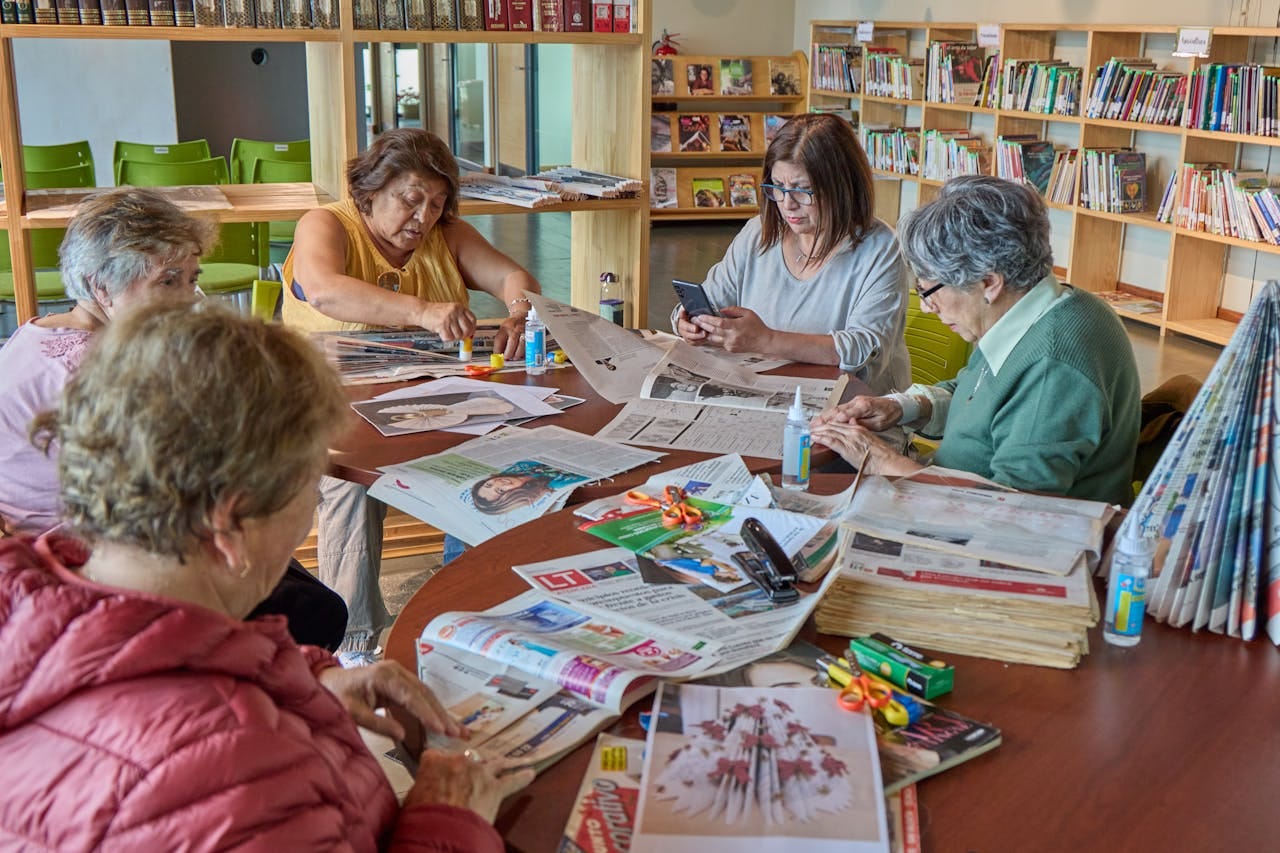
Julia tells us about the craft mornings she has started in the common room of her retirement village.
They weren’t part of a program. No committee. No formal approval.
She simply noticed that some women rarely left their rooms.
So she invited them.
A table. Some materials. A reason to come down.
Now the room is alive on those mornings—conversation, laughter, hands busy with small things. The kind of activity that doesn’t look like much from the outside, but changes the feel of a place from within.
They come. They love it.
A man complains. He comes to the common room expecting quiet. Instead, he finds himself surrounded by women talking, moving, engaging.
It’s not what he wants from the space.
Julia tells him he could find somewhere else to sit.
Management steps in.
They don’t look at the room. They don’t see the women. They reach for the rules.
Discrimination policy. Shared space. Equal access.
Julia is read the guidelines.
Nothing unusual in this. In fact, it’s exactly what we expect.
Systems are designed to be fair.
They rely on rules to ensure consistency.
At that level, the situation is straightforward:
one group using a shared space
another resident objecting
a need to apply policy evenly
The system can see all of that clearly. But something else is happening here.
Something that doesn’t register at that level.
At small-scale, Julia can see what those mornings actually mean.
Not a “craft group.”
A point of entry.
A reason to leave the room.
A place to sit with others.
A way back into participation.
She can see the difference between noise and life.
She can see what is changing for those women.
The system can’t.
Not because it’s badly designed.
But because it’s not designed to see that kind of thing.
Rules work by generalising.
They flatten situations into categories:
fair/unfair
compliant/non-compliant
allowed/not allowed
They have to. That’s how they scale.
But life doesn’t organise itself that way.
What sustains a life is rarely general. It’s specific. Local. Contextual.
A particular room. A particular group of people. A particular moment where something shifts from isolation to connection.
This is the tension.
At scale, the system sees policy.
At small-scale, a person sees what’s needed.
It shows up everywhere once you start noticing it.
In aged care systems that assess needs through forms and categories.
In organisations where decisions are made far from the people they affect.
In any setting where consistency is prioritised over context.
And yet, we need systems.
Without them, there is no structure, no coordination, no shared framework to operate within.
The problem isn’t that systems exist. It’s that they inevitably lose sight of what can only be seen up close. Which leaves us with a question.
Not how to fix the system. But how to live within it.
Because at some point, someone has to do what Julia did.
Notice.
Act.
Create something small and specific that works in this place, with these people, now.
Something that doesn’t require permission to begin.
Something that makes a difference at the level where life is actually lived.
The system may or may not accommodate it. It may reshape it, restrict it, or override it entirely. That part isn’t always in our control.
But the act itself matters.
Because it restores something that large systems can’t provide:
The ability to see clearly.
To respond appropriately.
To care in a way that fits the situation.
The common room becomes alive for a few hours.
Women who stayed in their rooms come out.
Conversation happens.
Hands move.
Something shifts.
From the outside, it’s just a craft group.
From within, it’s something else entirely.
At scale, the system can only see policy.
At small-scale, Julia intuitively knows what sustains a life.
My favourite reads this week:
You Set It Down So Gently You Didn’t Hear It Go by Katherine
Aging Gracefully by David Kellis
11 Must-Read Books That Will Change Your Life by Mark Ragland
Thanks for the shoutout!
Your article made me think of the time I taught a writing class at a Sr Citizens' Center. I knew I was going to show them how to write & organize their personal stories for their families, but I didn't really realize how much they would end up supporting each other. It actually turned into a friendship circle or therapy group. One man who was dying of cancer felt safe to share his fears. A woman who ran away with a priest was able to bare her soul. Yikes! No system created the extraordinary love I saw in those 6 weeks. ~js