

I have been reading Thinking on My Feet by Kate Humble.
I am in awe of how she carries the reader along paths in the English countryside—paths shaped by seasons, rituals, and centuries of use. In that world, life feels rhythmically structured. There is always something to notice, because the landscape insists on it.
Having visited the UK almost annually for over twenty-five years, I’ve walked those paths. I’ve felt the crunch of frost underfoot, wandered through Christmas markets, stood watching village duck races in the summer sun. The texture is undeniable.
Here, on the east coast of sub-tropical Australia, it is different.
The seasons are quieter. The shifts are subtle. There is continuity rather than contrast. Fewer rituals. Less imposed rhythm.
We live more in time than by the calendar.
But the signals are there if you look.
The humidity eases around Easter, allowing blue skies and pleasant temperatures to run the show for a while. Magpies and plovers nest in September. Screeching black cockatoos return to decimate banksias for their seed, leaving pods scattered everywhere. Jacarandas bloom in October, soft purple markers of the run toward Christmas. Poincianas follow, loud and red. November storms roll in, and humidity returns, completing the cycle.
It is Easter now. A calendar marker, even here.
Daylight saving ends. An extra hour of sleep. Clocks realign between NSW and Queensland for those of us living on the border.
And the visitors arrive.
Families pour in for the long weekend and school holidays. Our quiet rhythms dissolve. Parking spots vanish. Paths fill. The familiar becomes crowded.
We feel it this morning.
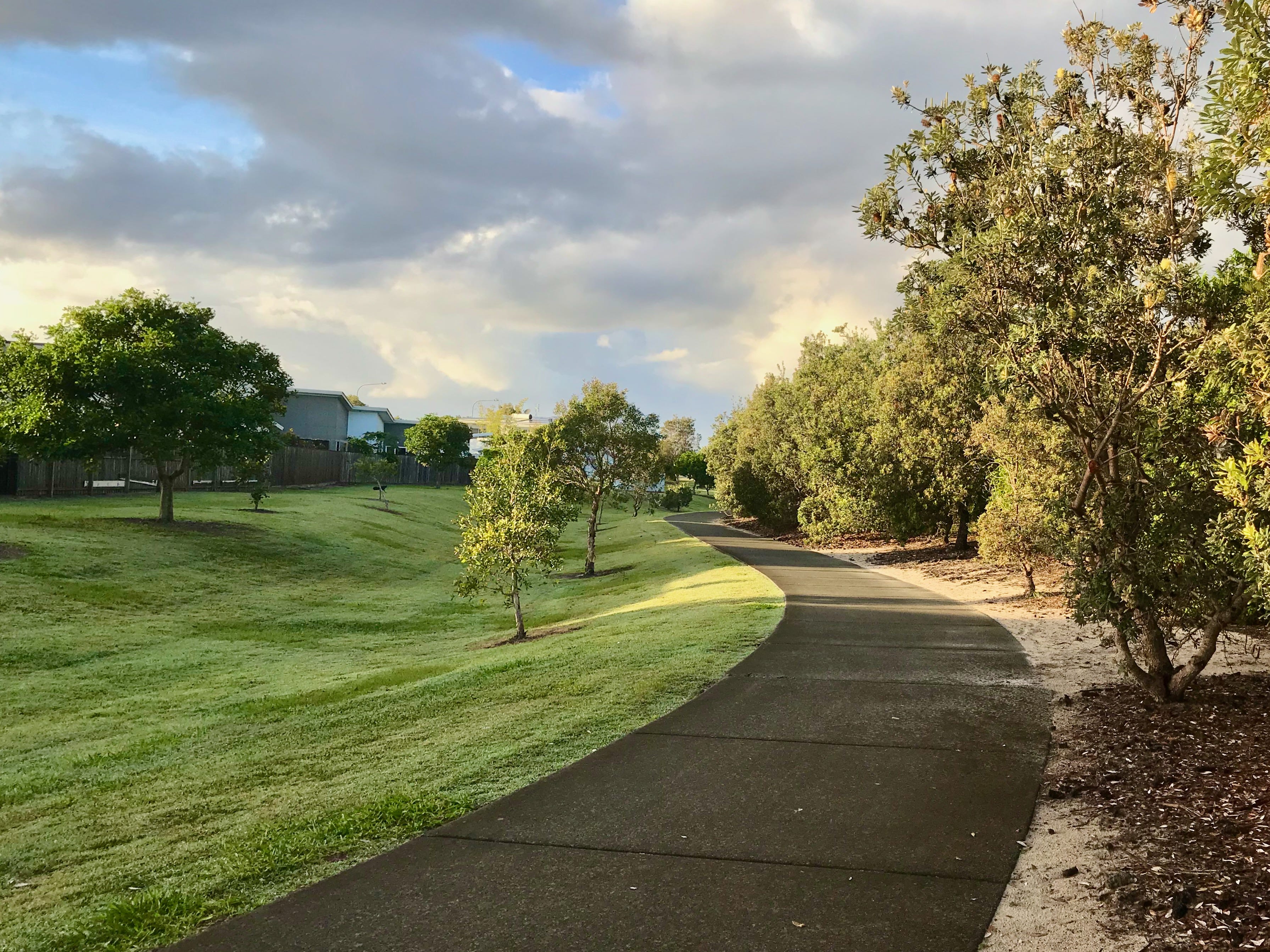
We chose a different route, avoiding the one our feet instinctively follow. Cutting through the houses, we join the beachside path heading north.
Merging onto it requires something close to a give-way sign. We join the flow.
Lorikeets fill the air with loud, insistent chatter from the trees lining the path. Fallen leaves—our version of autumn—lay damp and flattened, pressed into the concrete after weeks of rain. Some have left their imprint behind.
A bush turkey hovers at the edge of the path, pecking. Frank eyes it with mischief. I give him a look. Not today.
We step over uneven sections of concrete, pushed up by tree roots, and painted a cautionary yellow. The path tells its own story if you pay attention.
The surfers’ car park is full of potholes, holding the week’s rain, but oddly quiet. A glance toward the beach confirms it—lazy, sloshing waves. No real surf. Just sunlight catching the surface.
We cross the bridge and pause.
The creek is low; the tide is on its way in. To the right, dark water waits for the incoming tide to clear it. To the left, the eye travels inland to Mount Warning (30 kms away)—sacred, steady, catcher of Australia’s first rays of the day.
We turn for home.
And that’s when I notice it again—the path.
It winds for miles in both directions. Concrete. Man-made. Reliable. Used every day by walkers and cyclists like us.
I have always thought it one of the best features of where we live.
But reading Kate Humble, I find myself longing for something else. A muddy path. A woodland track. Something older. More textured.
And then it struck me.
This path is not lacking.
It is simply different.
The texture is here—just quieter. Less dramatic. Less curated by tradition. It asks more of the observer.
Perhaps that is the work.
Not to wish for a different landscape, but to see this one more clearly.
Favourite reads this week:
Your Biology Wasn’t Built for Modern Life by Ollie J. Whitby
Osteoporosis Prevention and Treatment: How Much Force Do Your Bones Need? by Howard Luks MD
Never Too Late to Launch: How 70‑ and 80‑Somethings Are Building Tech Businesses by The Senior Techie