
Joey and the Pacemaker
What walking 100+ km solo through Italy taught my childhood friend about friction, freedom, and defying expectations at 70.

Welcome to Age with Attitude, where I have upgraded that one question to:
What’s possible as we age?
There comes a point in our lives when the world subtly asks us to shrink.
Around the time of retirement, the cultural script is practically written for us:
Sign up for an organized tour,
Stay close to the guide,
Let someone else handle the bags,
Keep your life safely on the tracks.
It makes complete sense. Why take risks? You’ve earned the right to relax.
An all-inclusive itinerary, an air-conditioned coach, and a pre-packaged schedule sound fun, sensible, and safe. You don’t have to worry about getting lost, dealing with language barriers, or straining a muscle.
So we settle.
We protect what we have, stay where it’s comfortable, and start living life at a careful, pre-measured pace.
But quietly, beneath the surface, a subtle trade-off is happening. In exchange for safety, we start to surrender our agency.
Here is the uncomfortable truth about the ultimate safety net:
When you pay someone to handle your life, your world begins to shrink.
When you sit on the tour bus watching the world pass through a double-glazed window, you aren’t really encountering life. You’re a spectator. The moment you delegate every decision, every route, and every potential problem to someone else, your personal power begins to atrophy.
Safety can easily become a holding pattern.
True vitality doesn’t come from avoiding friction. It comes from direct interaction with life. It comes from solving small problems, navigating unknown paths, and realizing that your capacity to handle life doesn’t expire when you turn 70.
Let me tell you about my friend Jo.
We grew up together in a hot, dusty rural Australia in the 1960s—living on the same street, going to the same schools, sharing the exact same classroom. But, Jo’s family faced the harsh reality of a genetic heart condition, losing two of her brothers far too young.
After school, we went our separate ways, eager to get away from our small town to anywhere else.
Fast forward through life to our mid-sixties. Jo had retired from teaching, started experiencing heart issues, and was being monitored annually. She always knew a pacemaker was somewhere on the horizon, but when her doctor finally said, “It’s time,” she assumed he meant over the next few months.
“I can operate in four days.”
The suddenness shocked her. Her mind tumbled into a dangerous holding pattern—that dark feeling of just “waiting around to die.” Her father had passed away at 71, and she was fast approaching that exact milestone.
She bounced out of that downer with a single, firm decision:
A pacemaker and a ticking clock didn’t mean life was over.
She set herself a brand-new target:
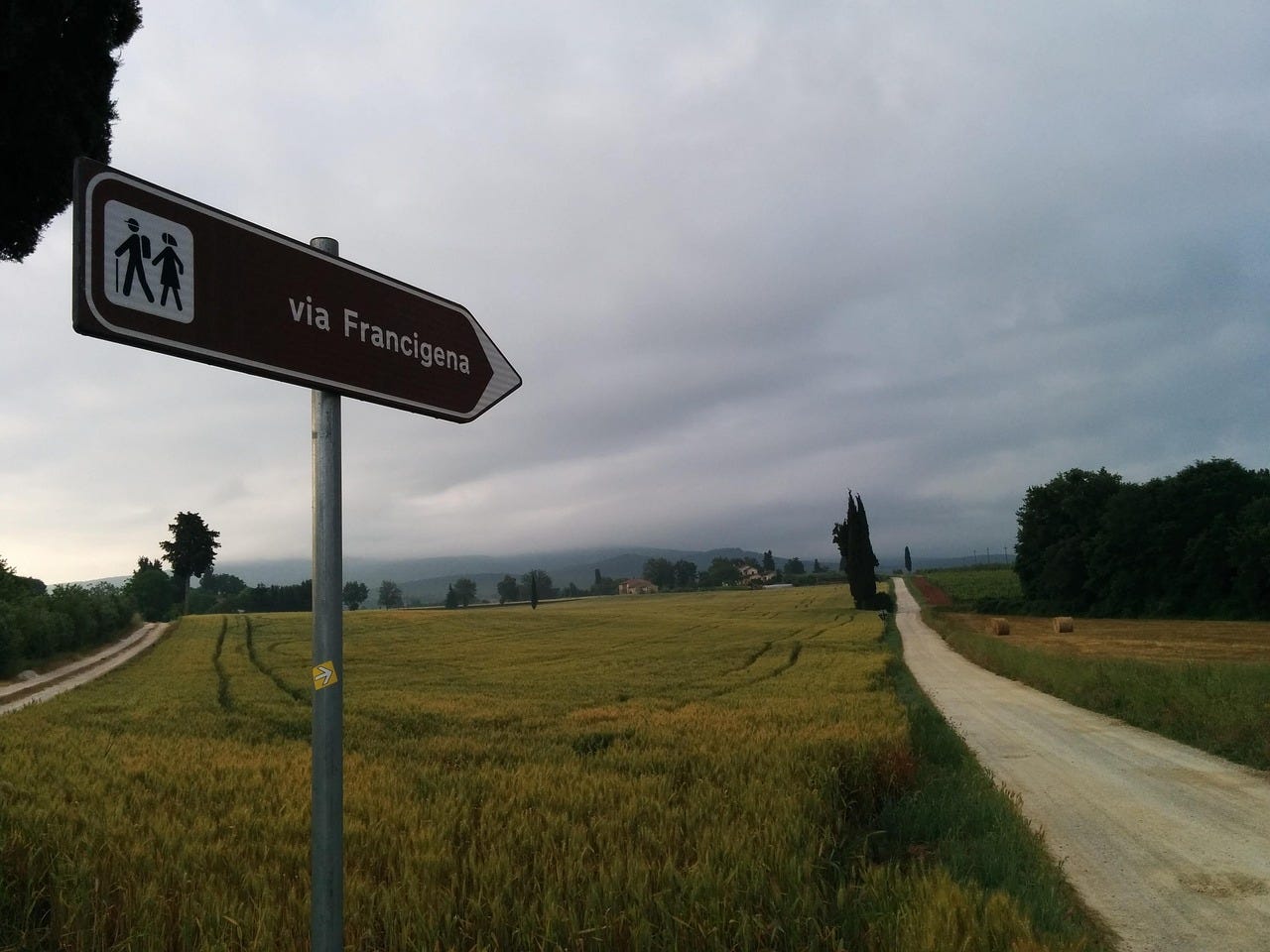
A solo pilgrimage along Italy’s ancient Via Francigena.
She kept the plan close to her chest to avoid well-meaning friends trying to talk her out of it or gatecrash her solitude. She joked that she was simply “taking my pacemaker for a walk in Italy” and set up a private Facebook group called Joey and the Pacemaker!
At home in Australia, she packed an ultra-light 5 kg backpack. She secured the few hundred grams of heart medications in a dry bag and shaved weight everywhere else—even cutting the tags off her clothes. Adding her daily drinking water brought the pack to around 7 kg. Her strategy was lean: buy what she needed on the road, then donate it before flying home.
Each morning, her navigation strategy was simple and sharp: memorize the GPS route at her accommodation, hold the map in her head, and start walking.
Her first attempt in 2024 hit real physical friction. Heavy rain, thick mud, and severe ankle pain forced her to walk sideways down steps like a crab. Combined with protein-scarce village diets and early-stage osteopenia, she made the hard call to abandon the walk.
When she got back home, it bugged her that she hadn’t finished. Did she settle quietly back into retirement? Not a chance. She recalibrated and, in October 2025—just weeks before her 70th birthday—she flew back to Italy to finish what she had started.
Equipped with hard-won experience, she covered 100+ kilometers from Acquapendente all the way to Rome.
Walking at a deliberate 3 km/h allowed her to drop into a state of hyper-presence.
You hear running water, and you know you’ll probably have to cross a stream. You find yourself surrounded by angry farm dogs, so you summon whatever it takes to speak calmly to them while yelling for an owner. You navigate the local hunting season, gunshots in the distance adding an undeniable edge to the trail. And you share home-cooked meals with generous local families, perhaps the ultimate reward for a pilgrim.
At one lunch stop, a group of young backpackers mentioned hearing rumors of a legendary 70-year-old woman walking the trail solo with a pacemaker. It took Jo a couple of minutes to realize... they were talking about her.
Another afternoon, she stoically turned down an offer of overnight accommodation from a host family to push on to her planned destination. Before long, it started pouring, dusk was settling over the hills, and the path’s signpost had fallen over. Just in time, two young brothers pulled up in a car and offered her a lift. She accepted (a little improvised hitchhiking!) and made it safely to her door—more local generosity with a smidge of adventure thrown in.
She celebrated her 70th birthday alone—but not lonely—at a luxurious hotel (a rare treat for an otherwise frugal traveler) and celebrated what she had accomplished.
When people argue about what makes a real pilgrimage—debating whether paying for a luggage transfer or taking a bus is “cheating”—Jo bypasses the noise entirely.
“It’s an individual thing,” Jo told me. “You have to know yourself. What others say doesn’t matter. I knew I could plod along, pace myself, and just keep going. And if I had to catch a bus, so be it. That mindset is my superpower.”
Jo didn’t do this because she possesses supernatural strength. She did it because she refused to hand over her independence to age, illness, or societal expectations.
As Jo put it: “If you know people who’ve done these things, you can fit yourself into the picture.” That’s the power of role models.
You don’t have to fly to Rome or strap on a backpack to take back your vitality. But you do have to look honestly at your daily life and ask:
Where have I stopped walking alone?
Where am I waiting for a companion, a guide, or “permission” before I step out?
You don’t need a tour guide to navigate your own life.
Start small. Take a route you’ve never walked. Handle a problem you’d normally hand off to someone else. Set your own pace, ignore the critics, and do it your way.
Rise above the noise.
Attitude is everything.
I’d love to hear how this lands for you.
Hit the Like button below, and let’s continue the conversation in the Comments.
For more inspiration, here are a couple of my favorite Substacks:
Helen The Walking Traveller by Helen The Walking Traveller
Rookie Outdoor Woman by Heidi Bonner
Lovely story about Jo! So inspiring and it underscores the importance of finding things that intrinsically motivate you to maintain your health, no matter what challenges you face.
Good on Jo!