
We Used to Live Here
What happens when we return to a place that once contained earlier versions of us?

Welcome to Age with Attitude, where I explore one question:
What sustains a life as we age?
I used to think the suburb we are currently enjoying as a home away from home was miles from anywhere. It is four kilometres from the city!
The place as I first knew it
In 1973, fresh out of school, living in a shared house only 3 kilometres from the city, I had a very small mental map of what counted as “near.”
My friends and I would catch the train at one stop from the city. You never got a seat, but you could revel in the knowledge that you were a city dweller. Mind you, the walk back from the station up the hill to our house perched at the top was an effort for this girl who grew up on flatland. However, the wide sweeping view of city lights as we sat on the front verandah to chat about our day was spectacular.
And when the devastating flood of 1974 arrived, that hill in Rosalie kept us safe as we watched a whole suburb below us being washed away.
I was aware of the suburbs slightly further from the city, like Ashgrove. I remember wondering who would choose to live “all the way out there.” I find that very funny now. Mind you, at that time it was farmland along the creek and being eyed off by developers, who were beginning to carve them up for housing.
Hills dominate these suburbs. Houses in Red Hill were built to hang off the sides of those hills, with front doors at street level, and backs suspended on extraordinarily high stilts so backyards were practically unusable.
Precarious as the hillsides looked, they beat the swamp on which the cottages below had been built.
These suburbs were working class to the core.
The place as it became
Three decades later, Frank and I purchased a city apartment in that dreaded next suburb, Ashgrove, that I thought was the end of the earth, still only four kilometres from the city. We used it during the week and returned to our tiny farm in the country at weekends.
We loved the proximity to work, the convenience, restaurants, and city life. Convenience was the buzzword of new owners of the day.
We drove everywhere. Public transport no longer seemed to belong to the life we were living.
In the intervening years, gentrification had begun to transform the area. The timber houses, dubbed Queenslanders, had wide verandahs designed to capture the summer breezes. Their large blocks must once have felt like heaven to an emerging office-worker class able to ride the tram into the city. Then a new professional class rediscovered their appeal and renovated them into modern homes retaining original character.
Still, there’s always the fear of flash flooding in the creek at the bottom of these hills. The water rises extremely fast, cars get parked further up the hill, and homeowners on the downside watch, wait and hold their breath. We even saw a shipping container used to store a tradesman’s tools picked up and jammed beneath a nearby bridge, so savage is the flow.
That will never change. The water wins every time.
The place as I see it now
Another 15 years on, we are house-sitting for my granddaughter and her partner around the corner from where our city pad was. It’s interesting to view it all through the eyes of another generation. We get to be temporary residents in an area that keeps drawing me back.
We try out public transport and marvel at how easily we manage the new technology, apart from one trip when Frank’s phone fails to tap out correctly. The mistake costs us $5 instead of the standard 50-cent fare, but even that is far less than we once paid.
We catch up with family for a casual Sunday breakfast, old school friends from fifty years ago for lunch, and my cousin, who walked across the footbridge over the river from his apartment to our city catch-up.
As we walked back to catch a bus home, it was lunchtime. Diners relaxed in outdoor cafes spilling onto the street. Others ate on the run, rushing to do errands in their lunch hour. I felt a flutter in my chest. For a moment, I was the country girl again, thrilled by the buzz of city life.
Back to our home away from home after catch-ups, we do our familiar walks up and down hills, testing our aging bodies against the inclines. Not quite covering the same distances as last time, but I still love to test my fitness. We are on the lookout for what has changed on our familiar old streets.
I notice the grand Queenslanders, now beautifully renovated, commanding not only prime real estate but also eyewatering prices that original owners could never have dreamt of.
I see the retirement village five-story building perched right beside the creek. I remember when it was first announced, thinking: that’s right, put the old people beside the flood-prone creek. How wrong I was. It is a grand, luxury building built to withstand whatever the creek may throw at it. Once again, with a modern price tag.
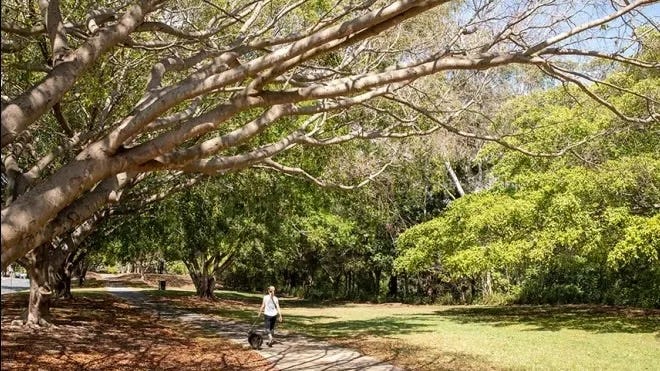
The mature suburb is abundant with grand trees. Groups of Landcarers tend the creek banks on weekends. There’s a sense of ownership of the public space. Mind you, all that shade makes perfect sense in our oppressive summer heat, but I’m looking for the places that offer a snippet of winter sun.
In the time I have lived in and around these inner-city suburbs, Brisbane has grown from a big country town to an adult city with two satellite cities connected by constantly busy freeways, and awash with new infrastructure projects as it prepares to host the 2032 Olympic Games.
I realise that the city has moved outward while my own sense of distance has changed too. These days, I can travel the 100 kilometres from our home by the beach to the city via a busy freeway simply to have lunch. The suburb I once thought was miles from anywhere now feels close to almost everything.
Places do not only change around us. Our sense of distance, convenience and belonging changes too.
Perhaps that is why I keep being drawn back here. Each time, the suburb introduces me to an earlier version of myself: the country girl thrilled by the city lights, the busy working woman who prized convenience, and now the older woman testing the hills, looking for winter sun and wondering what kind of place might sustain the life ahead.
I used to wonder who would choose to live all the way out here.
Now I wonder whether I might.
I’d love to hear how this lands for you.
Hit the Like button below, and let’s continue the conversation in the Comments.
My favorite reads this week:
Solitude Isn’t Always Lonely by Don Akchin
Don explores the sharp difference between feeling lonely and choosing solitude—and why being comfortable in your own company is a quiet superpower.
Does “Greasing the Groove” Work For Running? by Alex Johnson
After a break from Substack, I am happy to see Alex back with a must-read essay on why throwing out the standard fitness apps and designing his own running streak yielded his best results yet.
The Big Shift in Heart Health: What the New Cholesterol Guidelines Mean for Patients and Practice by William H Bestermann Jr MD
Dr Bill breaks down the historic new heart guidelines, showing how advanced screening and a 30-year risk window can protect your cardiovascular system early, ensuring we can stay active, vibrant, and free of chronic disease as you age.
A very enjoyable read, Robyn.
The line about 'the suburb introducing you to an earlier version of yourself' is a lovely way to put it. The country girl thrilled by the city lights is still in there somewhere.
I found myself getting nostalgic... but the other way around.
I moved from City life over 20 years ago now and love living in the countryside. But I do like to return and take a trip down that long, long memory lane occasionally.
I remember those villages that always seemed very distant from the city as I was growing up.
The distance has now evaporated; the villages have been consumed as the city expanded.
A bit sad really.
Great read, Thank You.
There's an old saying that you can never go back home. But you did and with a lovely perspective.